

FIFA World Cup Brackets 2026: Complete Tournament Bracket, Schedule & Predictions
The biggest FIFA World Cup 2026 in history is here. Forty-eight teams. FIFA World Cup Brackets Three host countries. One trophy. And if you’re like most American soccer fans this June, you’ve got one big question on your mind: how do I make sense of this bracket?
This guide breaks it all down. We’ll walk through the groups, the schedule, the knockout rounds, and even give you some bold predictions for who lifts the trophy at MetLife Stadium on July 19. Whether you want a printable World Cup bracket for your office pool or an interactive World Cup bracket to build online, you’ll find it here. Let’s dive in.
What Is the FIFA World Cup Bracket?
A World Cup bracket is simply a map. It shows how 48 teams whittle down to one champion. Think of it like a giant tournament tree. Group winners and runners-up earn automatic spots in the knockout stage. The best third-place qualifiers sneak in too, filling out the bracket to a clean 32 teams.
This isn’t a guessing game we invented. FIFA spells out the exact structure in their official FIFA regulations document. We’ve followed those rules closely so this guide matches what actually happens on the pitch. Once you understand the shape of the bracket, predicting it becomes a lot more fun, and a lot less confusing.
How the FIFA World Cup Bracket Works
So how does a team go from group play to lifting a trophy? It’s a step-by-step climb, and every step matters. Lose once in the knockout rounds, and you’re done. No second chances. No away-leg comeback. Just 90 minutes (sometimes more) to seal your fate.
This format rewards teams that show up ready every single match. There’s no coasting through the FIFA World Cup knockout rounds. Below, we break down exactly how the bracket flows from start to finish, and how teams punch their ticket to the next round.
Understanding the Knockout Stage Format
Once group play wraps up, it’s win-or-go-home. Every match in the knockout stage uses extra time and penalty kicks if needed. There’s no such thing as a draw once you reach the World Cup elimination bracket. This is the first World Cup ever to include a Round of 32 as the opening knockout round. That’s a direct result of FIFA expanding the tournament to 48 teams.
For fans, this means more drama, more matches, and more chances for an underdog to make noise. A team can lose its opening group match and still survive the bracket, as long as it bounces back and finishes well enough to qualify. That’s part of what makes this format so exciting to watch.
How Teams Advance Through the Tournament
The path looks like this: Group Stage, then Round of 32, then Round of 16, then Quarterfinals, then Semifinals, then the Third-Place Match and Final. Each round cuts the field roughly in half. By the time you reach the final, only two teams remain standing out of the original 48.
Here’s where it gets tricky. Third-place teams don’t get a fixed opponent. Instead, FIFA’s third-place qualification rules slot them into specific Round of 32 matchups based on which groups produced qualifying third-place finishers. For example, the Group A winner might face the third-place team from Group B, C, D, E, or F, depending on results elsewhere. It sounds complex, but our Round of 32 predictor further down this guide makes it easy to visualize.
FIFA World Cup Brackets 2026 Explained
Let’s zoom out for a second. Why does this tournament feel so different from past World Cups? Because it is different. Everything about the structure changed in 2026, from team count to match count to the number of host cities involved.
This section breaks down the raw numbers behind the 2026 FIFA World Cup, so you understand exactly what you’re working with before you start filling out your bracket.
Number of Teams in the 2026 FIFA World Cup
For the first time ever, 48 teams are competing. That’s up from 32 teams in every World Cup since 1998. Three nations are sharing hosting duties this year: the United States, Canada, and Mexico. It’s the first World Cup ever hosted by three countries at once, and the World Cup host cities stretch across all three nations.
This expansion means more countries get a shot at World Cup glory. Smaller soccer nations like Curaçao and Cape Verde are making their first-ever appearances. That’s a big deal, and it adds fresh storylines to an already massive tournament.
Group Stage and Knockout Structure
Here’s the math fans search for most. There are 12 groups, each with 4 teams. That adds up to 104 total matches across the whole tournament. Of those, 72 are group-stage games. The remaining 32 are knockout matches.
The top 2 teams from each of the 12 groups advance automatically. That’s 24 teams. The other 8 spots in the Round of 32 go to the best third-place qualifiers across all 12 groups. Below is a quick table breaking down how the numbers stack up.
| Stage | Number of Teams | Number of Matches |
| Group Stage | 48 | 72 |
| Round of 32 | 32 | 16 |
| Round of 16 | 16 | 8 |
| Quarterfinals | 8 | 4 |
| Semifinals | 4 | 2 |
| Third-Place Match & Final | 2 | 2 |
Round of 32, Round of 16, Quarterfinals, Semifinals and Final
Each round cuts the field down fast. Thirty-two teams become sixteen. Sixteen become eight. Eight become four. Four become two. And two become one champion. The Third-Place Playoff still exists too, giving the two losing semifinalists one more match for bronze.
This year, the third-place match happens at Hard Rock Stadium in Miami, one day before the final. It’s a nice tradition that gives fans one extra big match to watch before the World Cup final prediction showdown happens at MetLife Stadium.
FIFA World Cup 2026 Bracket (Updated)
The group stage kicked off on June 11, 2026, and the bracket is already taking shape. Right now, you can see confirmed placeholder slots in the official bracket, like “1E vs 3rd A/B/C/D/F.” These slots fill in with real team names as group standings lock into place.
This section of our guide updates regularly. As more group matches wrap up, the FIFA World Cup standings predictor below adjusts to reflect real results. Bookmark this page if you want a single place to track the bracket as it evolves.
Printable FIFA World Cup Bracket
Want something you can hold in your hands? We offer a clean, printable World Cup bracket you can download and fill in by hand. It’s perfect for office pools, family game nights, or watch parties with friends. The bracket includes blank slots for all 32 Round of 32 matchups, all the way through to the final.
Printing your bracket also makes it easier to compare notes with coworkers or family members who aren’t online as much. Sometimes a pen and paper beat a screen, especially when bragging rights are on the line.
Interactive World Cup Bracket Simulator
This is where things get fun. Our World Cup bracket simulator lets you predict all 12 groups, choose your own 8 third-place qualifiers, and then run through knockout scenarios using FIFA’s actual regulations. There are 495 different possible combinations for how third-place teams can be slotted into the bracket, and this tool handles all of them automatically.
You can also save and share bracket predictions with friends, join group leagues, and compete on a global leaderboard. It’s basically a World Cup prediction game built for serious fans who want more than a static printable sheet.
Live FIFA World Cup Bracket Updates
Once matches kick off, this section refreshes with real scores and bracket movement. You’ll see who’s clinched a knockout spot, who’s been eliminated, and how the third-place qualifiers calculator shifts as more group games finish. No need to dig through ten different score sites. It’s all here in one place.
FIFA World Cup 2026 Groups and Standings
As of mid-June 2026, most groups have already played their opening matchday. A few groups are just getting started. Below, we break down where every group stands right now using our World Cup group stage simulator data, pulled straight from live results.
Remember, these standings shift fast. A single result can flip a group’s order overnight. Check back often if you want the freshest picture.
Group A
Mexico, the co-host nation, currently sits tied atop Group A alongside South Korea. Both teams have 3 points. Czechia and South Africa sit at zero points each after the opening matchday. Mexico’s home crowd advantage is already showing, with a positive goal difference through one game.
| Team | Points | Goal Difference |
| Mexico | 3 | +2 |
| South Korea | 3 | +1 |
| Czechia | 0 | -1 |
| South Africa | 0 | -2 |
Group B
Group B is the tightest group in the tournament so far. Switzerland, Canada, Qatar, and Bosnia and Herzegovina are all tied with 1 point each and a goal difference of zero. This group looks wide open, and nobody has separated from the pack yet.
Canada, as a co-host nation, will feel pressure to push ahead in upcoming matches. Fans expect this group to stay close right through the final matchday.
Group C
Scotland leads Group C with 3 points after a surprising start. Brazil and Morocco sit tied for second with 1 point apiece. Haiti, in their first World Cup appearance since 1974, currently sits at the bottom with zero points.
Brazil’s slow start has already raised eyebrows among soccer fans. Five-time champions don’t usually open slowly, so expect a response in their next match.
Group D
This is the group every American fan is watching closely. The USA, as co-host, leads Group D with 3 points and a strong +3 goal difference. Australia sits close behind with 3 points and a +2 goal difference. Türkiye and Paraguay are both at zero points.
This group has real World Cup history packed into it. The USA’s best-ever finish came in 1930, when they took third place. A strong run here would be a huge moment for soccer fans across the country.
Group E
Germany leads Group E in dominant fashion, sitting at 3 points with a massive +6 goal difference. Ivory Coast follows with 3 points and a +1 goal difference. Ecuador and Curaçao both sit at zero points, with Curaçao struggling at -6 goal difference in their historic first-ever World Cup appearance.
Germany’s four World Cup titles make them a constant threat, and this opening result backs up the pre-tournament hype around their squad.
Group F
Sweden surprised everyone by jumping to the top of Group F with 3 points and a +4 goal difference. Japan and the Netherlands are tied for second with 1 point each. Tunisia sits last with zero points and a -4 goal difference.
The Netherlands, usually a tournament favorite, will need a response fast if they want to avoid an early scare in this group.
Group G
Group G is dead even right now. Belgium, Egypt, Iran, and New Zealand are all tied with 1 point each and a goal difference of zero. This is shaping up to be one of the most unpredictable groups in the entire 2026 FIFA World Cup.
New Zealand, often considered a long shot, has already shown they belong on this stage by matching results with much bigger soccer nations.
Group H
Like Group G, this one is also a four-way tie. Uruguay, Saudi Arabia, Spain, and Cape Verde all sit with 1 point each. Spain being level with the rest of the group is already a notable early storyline.
Cape Verde making their first-ever World Cup appearance and grabbing a point right away is a feel-good moment for the tournament’s smaller nations.
Group I
Norway currently leads Group I with 3 points and a +3 goal difference, ahead of pre-tournament favorites France, who also have 3 points but a smaller +2 goal difference. Senegal and Iraq both sit at zero points so far.
Norway’s hot start has surprised plenty of soccer fans, especially given France’s deep, talented roster heading into this tournament.
Group J
Argentina leads Group J comfortably with 3 points and a +3 goal difference after a 3-0 win over Algeria. Lionel Messi continues chasing World Cup history in what may be one of his final tournament appearances. Austria and Jordan have yet to play their opening matches.
Algeria sits at zero points and -3 goal difference after that opening loss, putting early pressure on their next match to stay alive in the group.
Group K
Group K features Portugal, DR Congo, Uzbekistan, and Colombia. None of these matchups have happened before in World Cup history, so every result will be a first. This group has not started play yet, but it’s worth watching closely once matches begin.
Portugal enters as a clear favorite, but Colombia’s recent form makes them a dangerous second seed in this group.
Group L
Group L includes Croatia, England, Ghana, and Panama. Like Group K, this group has not kicked off play yet. England enters with high expectations after past tournament runs, while Croatia brings deep knockout-stage experience from recent World Cups.
Panama’s appearance adds another fresh storyline, as Central American soccer continues growing on the world stage.
FIFA World Cup 2026 Match Schedule
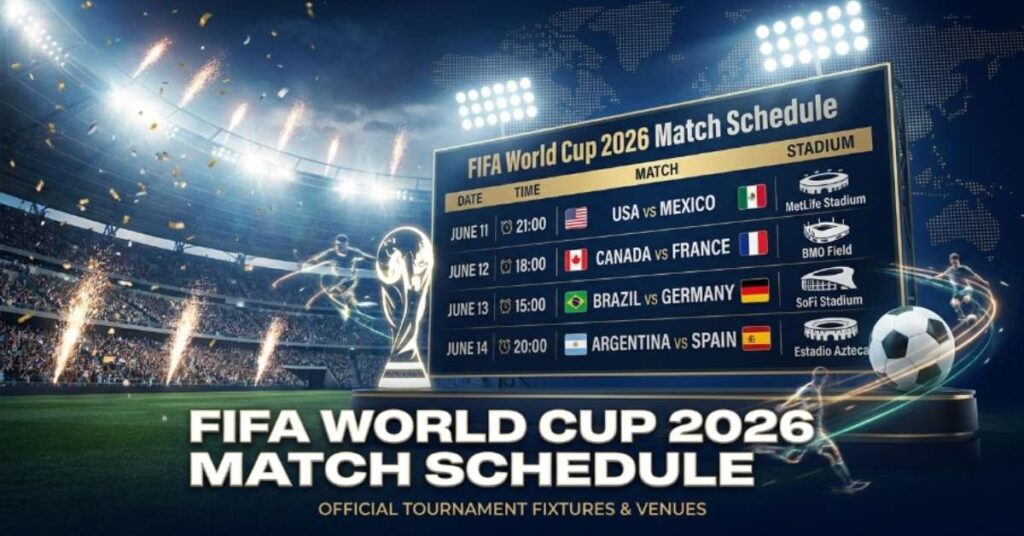
Knowing when to watch matters just as much as knowing who’s playing. The match schedule and fixtures for this tournament span more than five weeks, stretching across three countries and dozens of cities.
Below, we break the schedule into two simple parts: group stage dates and knockout stage dates, so you can plan your viewing (or your World Cup travel planning) accordingly.
Group Stage Schedule
Group play runs from June 11 through June 27, 2026. Matches are spread across host cities in the United States, Canada, and Mexico. Early matches kicked off in Mexico City and Guadalajara, with more cities joining as the schedule progressed.
Fans tracking specific teams should check daily schedules closely, since kickoff times vary by host city and time zone. With three countries hosting, time zone differences matter more this year than in past tournaments.
Knockout Stage Schedule
The Round of 32 runs from June 28 through July 4. The Round of 16 follows immediately after, running July 4 through July 7. Quarterfinals take place July 9 through July 11. Semifinals follow on July 14 and July 15. The Third-Place Match happens July 18, with the Final on July 19.
| Round | Dates |
| Round of 32 | June 28 – July 4 |
| Round of 16 | July 4 – July 7 |
| Quarterfinals | July 9 – July 11 |
| Semifinals | July 14 – July 15 |
| Third-Place Match | July 18 |
| Final | July 19 |
FIFA World Cup Final Date and Venue
The final lands on Sunday, July 19, 2026, at MetLife Stadium in East Rutherford, New Jersey. During the tournament, FIFA refers to the venue as “New York New Jersey Stadium” due to sponsorship rules. Kickoff is set for 3 p.m. Eastern Time, and the 82,500-seat stadium is the largest venue in the entire tournament.
The halftime show reportedly features Madonna, Shakira, and BTS, curated by Coldplay’s Chris Martin, which would mark the first time a World Cup final has included a major halftime performance like this. MetLife Stadium also hosts seven other matches across the tournament, including group games, a Round of 32 match, and a Round of 16 match, making it one of the busiest venues of the whole event.
FIFA World Cup Bracket Predictions
Now for the fun part. Based on early group results, FIFA rankings, and tournament history, here are our predictions for how this bracket plays out. Keep in mind, it’s still early. The group stage isn’t finished, and plenty can change between now and the final.
These FIFA tournament predictions are meant to spark debate, not settle it. Use them as a starting point for your own picks in the bracket simulator.
Predicted Round of 32 Teams
Based on current form, expect group winners like the USA, Argentina, Germany, Norway, Sweden, and Mexico to advance comfortably. Brazil and the Netherlands should still find a way through despite slower starts, given their squad depth and tournament pedigree.
The most interesting Round of 32 predictor storylines will involve which third-place teams sneak through. Don’t be surprised if Cape Verde, DR Congo, or Curaçao make a surprise push into the knockout stage.
Predicted Quarterfinalists
Expect Argentina, France, Brazil, and Germany to anchor four of the eight quarterfinal spots. The USA, playing with home crowd energy across multiple stadiums, has a real shot at reaching this stage too. Portugal and England round out our predicted final eight.
History favors experienced knockout-stage teams here. Squads that have been through penalty shootouts before tend to handle the pressure better when it matters most.
Read More: Latest FeedBuzzard Com (2026 Guide): What It Is, How It Works & Why Everyone Is Talking About It
Predicted Semifinalists
Our semifinal predictions point toward Argentina, France, Germany, and the USA. This would mark a major milestone for American soccer, should the co-host nation reach this far. Of course, Brazil and Portugal remain dangerous enough to disrupt this picture entirely.
Semifinal matches always bring extra intensity, since one slip means settling for the Third-Place Playoff instead of a shot at the trophy.
Predicted Final Matchup
Our bold call: Argentina versus Germany in the final. Both nations bring deep World Cup history, strong squads, and proven big-game players. It would be a rematch of soccer royalty on the sport’s biggest stage, played in front of a packed MetLife Stadium crowd.
Predicted FIFA World Cup Winner
Our World Cup champion predictor leans toward Argentina lifting the trophy. With Messi possibly playing his final World Cup, the emotional pull combined with Argentina’s roster depth makes them our pick. That said, this prediction will keep evolving as the tournament unfolds, so check back often.
FIFA World Cup Bracket Simulator
Reading predictions is fun, but building your own bracket is even better. Our FIFA bracket generator walks you through every step, from group picks to your final champion call. It’s designed for casual fans and serious soccer heads alike.
Whether you’re filling out a bracket solo or competing with an entire office pool, this tool makes the process simple and genuinely enjoyable.
How to Create Your Own World Cup Predictions
Start by picking your group winners and runners-up for all 12 groups. Next, select your 8 third-place qualifiers. From there, build out your knockout rounds one matchup at a time, all the way to your predicted champion. The whole process takes just a few minutes once you get the hang of it.
This tool functions as both a World Cup fixture simulator and a group stage prediction tool, so you’re covering every angle of the tournament in one place.
Best Strategies for Filling Out a World Cup Bracket
Smart bracket builders weigh FIFA rankings heavily, but they don’t ignore upset potential. Watch for fatigue and travel disadvantages between host countries, since teams bouncing between Mexico, Canada, and the US face different climates and altitudes. Head-to-head history also matters more than people think.
Don’t be afraid to pick at least one underdog deep run. Cape Verde, DR Congo, or Curaçao could be this tournament’s version of Morocco in 2022. Bold picks make for more fun brackets, even if they don’t always pan out.
Share Your World Cup Bracket Picks
Once your bracket is complete, you can save and share bracket predictions with one click. The tool generates a clean results-summary graphic, perfect for posting on Instagram or X. You can also share bracket with friends directly or create a private group to track everyone’s picks side by side.
This social layer turns a simple prediction tool into a full World Cup bracket challenge game, the kind that keeps friend groups talking through the entire tournament.
FIFA World Cup Bracket History
Every great bracket prediction starts with a little history. Knowing what’s happened before helps you spot patterns and make smarter calls for 2026. This section looks back at champions, upsets, and surprise runs that shaped how fans approach bracket predictions today.
Past tournaments also remind us why this sport stays so unpredictable. No matter how strong the favorites look on paper, the World Cup elimination bracket has a long history of humbling them.
Past FIFA World Cup Champions
Brazil leads all nations with five World Cup titles. Germany and Italy each have four. Argentina and France are tied with three apiece. These five nations have combined to win the vast majority of all World Cups ever played, which says a lot about depth and tournament experience.
| Nation | World Cup Titles |
| Brazil | 5 |
| Germany | 4 |
| Italy | 4 |
| Argentina | 3 |
| France | 3 |
Memorable World Cup Bracket Upsets
Soccer fans still talk about South Korea’s stunning run to the semifinals in 2002 as co-hosts. Senegal shocked defending champions France in the opening match of that same tournament. The USA’s win over England in 1950 remains one of the biggest shocks in World Cup history, decades before most fans alive today were even born.
Upsets like these are exactly why bracket predictions never feel pointless, even when the favorites look unbeatable on paper.
Biggest Surprises in World Cup Knockout History
Some surprises go beyond a single upset. Croatia’s run to the 2018 final and Morocco’s historic push to the 2022 semifinals stand out as full tournament surprises, not just one shocking result. These runs prove that a single hot tournament can carry a team further than anyone expected.
Watching for a team like this in 2026 adds an extra layer of excitement to filling out your bracket. Could Cape Verde or DR Congo be this tournament’s surprise story?
FIFA World Cup Statistics and Records
Numbers tell their own story in this tournament. Here’s a quick look at the records that matter most heading into the 2026 World Cup.
Most Successful Nations in World Cup History
Brazil’s five titles remain the gold standard. Germany and Italy follow with four each, while Argentina and France share third place with three titles apiece. These nations enter every tournament as favorites, and 2026 is no different.
Most Goals Scored in a World Cup
France’s Just Fontaine still holds the record for most goals in a single World Cup, scoring 13 goals back in 1958. That record has stood for decades and remains one of the most untouchable marks in the sport. Watching whether anyone even comes close in 2026 will be a storyline worth following.
Read More: WallPostMedia com Review 2026: Complete Guide to Features, Pricing, Pros, Cons, and How It Works
Players With the Most World Cup Appearances
Lionel Messi continues chasing history in 2026, adding to an already legendary World Cup résumé. Germany’s Lothar Matthäus previously set the high bar for total World Cup appearances, and Messi’s continued presence on the pitch keeps that record conversation alive heading into this tournament.
Frequently Asked Questions
What Is the FIFA World Cup Bracket?
It’s the structure showing how 48 teams narrow down to one champion through group play and knockout rounds. Group winners, runners-up, and the best third-place teams all earn spots in the Round of 32.
How Many Teams Are in the FIFA World Cup 2026?
There are 48 teams competing, the most in World Cup history. This marks the first expansion since the tournament moved to a 32-team format back in 1998.
Where Can I Find a Printable World Cup Bracket?
You can download our printable World Cup bracket directly from this guide. It includes blank slots for every Round of 32 matchup through the final, ready to print and fill in by hand.
Can I Predict the FIFA World Cup Using a Bracket Simulator?
Yes. Our interactive World Cup bracket simulator covers all 495 possible FIFA knockout scenarios for third-place qualifiers, based directly on FIFA’s official regulations. You can build, save, and share your full bracket prediction in just a few minutes.
How Often Is the World Cup Bracket Updated?
The bracket updates as soon as new match results come in. This matters most during the group stage, when third-place rankings shift constantly based on goals scored, goal difference, and points earned across all 12 groups.
Final Thoughts
This FIFA World Cup Brackets 2026 hub will keep updating all the way through July 19. Bookmark this page, build your bracket, and check back often as results roll in. The biggest moments, and maybe your bracket’s biggest upsets, are still ahead. Good luck, and enjoy the ride.