

Joincrs com: The Complete Guide to Using This Powerful Classroom Tool in 2026
It’s 8:58 a.m. The bell hasn’t even rung yet, and three students already can’t log in. One forgot a password. One is stuck on a school portal that’s down again. One just stares at the screen, unsure what app to even open. Sound familiar? For thousands of teachers across the US, this isn’t a bad day. It’s just Tuesday.
That’s the exact headache Joincrs com was built to solve. No flashy redesign. No giant app to download. Just a simple idea: one website, one short code, and you’re in. joincrs.com works as the student entry portal for a digital classroom platform called Classroomscreen, and it’s quickly becoming a go-to tool in classrooms that want less friction and more actual teaching time.
This guide answers what is Joincrs com, how does Joincrs com work, and how to use Joincrs com in plain, everyday language. We’ll walk through why teachers like it, what students experience, and yes, the privacy questions too, because parents and schools deserve real answers, not vague marketing language. Think of this as a full Joincrs com guide, covering everything from setup to troubleshooting in one place.
What Is Joincrs com?
Joincrs com is a simple website. Students go there to join live classroom sessions. They don’t need an account. They don’t need a password. They just need a short code from their teacher.
Here’s the part that surprises people: joincrs.com is not its own app. It’s the virtual classroom portal that connects students to Classroomscreen, an interactive learning platform built for teachers. Think of Classroomscreen as the engine and Joincrs com as the front door. Teachers build and run sessions on Classroomscreen using a full set of teacher tools, and students walk through the Joincrs com door to get inside. This browser-based platform setup works across online classroom access scenarios, whether the class is fully remote, fully in-person, or somewhere in between, and it fits naturally into any digital learning routine a school already runs.
Is Joincrs com the Same as Classroomscreen?
Not quite, though the two are joined at the hip. Classroomscreen is the full teacher dashboard, the place where lessons get built, timers get set, and polls get launched. Joincrs com, on the other hand, is the online classroom entry point made just for students.
Picture a cockpit and a door. The teacher sits in the cockpit, flying the lesson with all its buttons and dials. Students walk through the door, which is joincrs.com, and they land right inside whatever activity the teacher has going. They never see the cockpit controls. They just see the lesson. That separation keeps things simple on the student side while giving teachers a full classroom management system behind the scenes.
What Is Joincrs com Used For?
Teachers use it to pull students into live, interactive moments during class. Maybe that’s a quick poll. Maybe it’s a five-question quiz to check understanding. Maybe it’s a mood check-in before a tough lesson. Joincrs com acts as the bridge for all of it.
Common uses include warm-up polls at the start of class, exit tickets at the end, live quizzes during a lesson, anonymous feedback on tricky topics, and collaborative whiteboard activities. Joincrs com for students means a quick, low-pressure way to answer honestly. Joincrs com for teachers means a steady stream of live data on who’s keeping up. Some schools also use it for classroom response system style check-ins, where every student answers at once instead of just the few kids who always raise their hands first. It fits into daily lesson flow without asking teachers to overhaul anything.
How Joincrs com Works
The mechanics are refreshingly simple. A teacher opens Classroomscreen and starts a live session. The platform spits out a short, six-digit code. That code becomes the key to the whole thing.
Students take that code, type it into joincrs.com, and they’re in. No waiting, no app store, no IT ticket. It usually takes under thirty seconds from “open browser” to “fully inside the lesson.” That speed matters more than it sounds like it should. A few seconds saved per student, multiplied across thirty kids and five class periods a day, adds up to real instructional time recovered. This is where the browser-based learning platform design earns its keep, since nothing needs installing on any device.
How Students Join a Session Using a Code
Wondering how to join a classroom session? It’s about as easy as typing a phone number. Students open any browser, go to joincrs.com, and a code box pops up right away. They type the six digits their teacher gave them, hit “Join,” and they’re inside the live session.
Teachers can also offer a QR code instead, which works great for younger kids who might fumble with typing. Either way, this enter classroom code online moment is what makes the whole system click. There’s no sign-up screen lurking behind it. No “create a username” step. Just the code, and then the class.
How Teachers Create and Manage Live Sessions
On the teacher side, things get a little more involved, in a good way. Teachers log into Classroomscreen and build their screen using one of over 150 templates, or they start from scratch with a blank layout. They drop in whatever tools the lesson needs: a timer, a poll, a traffic light widget, maybe a randomizer for picking who answers next.
Once the screen is ready, the platform generates the session code. Teachers share it however fits the moment, out loud, on a projector, through a QR code, or pasted into a Google Classroom announcement. From there, the teacher watches responses roll in live and can adjust the lesson on the fly. This is genuinely useful teacher dashboard functionality, because it turns a static lesson plan into something that reacts to what students actually understand in real time.
What Devices Support Joincrs com?
Almost anything with a modern browser works. That includes Chromebooks, which dominate US school device fleets, along with smartphones, tablets, laptops, and desktop computers. Nothing needs installing.
| Device Type | Works With Joincrs com? | Notes |
| Chromebook | Yes | Most common device in US schools |
| Smartphone (iOS/Android) | Yes | Fully mobile-friendly layout |
| Tablet (iPad, Android) | Yes | Great for younger students using QR codes |
| Laptop | Yes | Any modern browser works |
| Desktop computer | Yes | No special software needed |
This mobile-friendly learning portal design means schools don’t need to standardize on one device type. A student using a borrowed Chromebook and another using their own phone both land in the exact same session, side by side.
Key Features of Joincrs com
This rundown of Joincrs com features doubles as a quick Joincrs com tutorial for anyone setting things up for the first time. The feature set leans toward depth on the teacher side and simplicity on the student side, and that balance is intentional. As a live polling platform paired with a set of classroom feedback tools, teachers get a rich toolbox. Students get a clean, no-fuss screen with exactly what they need and nothing extra.
This split matters for a reason. Kids get distracted easily, especially younger ones, so a cluttered interface would work against the whole point of online student engagement. Teachers, meanwhile, need enough control to run a real lesson, not just a single gimmick widget. Splitting complexity this way keeps both sides happy.
What Teachers See on Classroomscreen
The teacher’s screen is where the real depth lives. Live polls sit at the center of it, letting teachers launch a question and watch answers populate within seconds. No more collecting paper, no more guessing who actually understood the reading.
Beyond polls, there are traffic light widgets, drawing tools for shared sketching, timers to keep pacing tight, and grouping tools for splitting the class into teams. Teachers also get real-time classroom interaction data, meaning they see exactly how students are responding while the lesson is still happening, not the next day after grading something.
What Students Experience Through Joincrs com
Students get something much simpler. After entering the code, they see one activity at a time. Big text, clear buttons, nothing crowding the screen. It feels less like software and more like answering a quick question from a friend.
One detail stands out here: anonymous participation. Unless the teacher turns names on, students answer without anyone seeing whose response is whose. That single design choice changes classroom dynamics more than people expect. Shy kids speak up. Wrong answers stop feeling embarrassing. This is anonymous student participation working exactly as intended, and it tends to pull in students who’d otherwise stay quiet all period.
Interactive Tools and Widgets Available in Joincrs com
The widget library covers a lot of ground without feeling bloated. Teachers can pick from polls, quizzes, traffic lights, sound level meters, randomizers, work symbols, daily agenda templates, wellbeing check-ins, and exit ticket formats.
| Widget Type | Best Used For |
| Live Poll | Quick opinion or knowledge checks |
| Traffic Light | Gauging understanding in real time |
| Timer | Pacing activities or transitions |
| Randomizer | Fair, unbiased student selection |
| Sound Meter | Managing classroom noise levels |
| Exit Ticket | Wrapping up a lesson with feedback |
These interactive lesson activities give teachers flexibility without forcing them to learn a complicated system. Most widgets take seconds to set up, which matters on a Monday morning when there’s no time to fuss with settings.
Real-Time Feedback and Classroom Collaboration Features
The traffic light system deserves its own spotlight because it’s such a clean idea. Green means “I’ve got this.” Yellow means “kind of, but I’m not sure.” Red means “I’m lost.” Students tap their color, and the teacher instantly sees the full spread.
That real-time feedback system turns a guessing game into actual data. A teacher staring at a sea of red lights knows to slow down and reteach right then, not three days later after a quiz reveals the gap. Pair that with collaborative whiteboard tools, and you get a setup that supports both quick checks and deeper group work, all inside the same classroom collaboration tools ecosystem. These virtual teaching tools work together as part of a broader suite of educational collaboration software, giving teachers more than just a single trick to lean on.
Why Joincrs com Uses a No-Account System
Plenty of EdTech platforms ask students to create profiles, set passwords, and remember usernames. Joincrs com skips all of that on purpose, which is why there’s no real Joincrs com login process to speak of beyond typing a temporary code. The thinking is simple: every extra step between “open laptop” and “join lesson” is a step that can go wrong.
This isn’t just a convenience choice. It’s a design philosophy that treats friction as the enemy of learning. Fewer logins mean fewer support tickets, fewer tears from a six-year-old who forgot a password, and fewer wasted minutes during a forty-minute class period. The no-login system approach sounds almost too simple, but that’s exactly the point.
Why Students Do Not Need an Account
No account means no email collected, no password to reset, and no profile sitting in some database waiting to be hacked. Students just need the code their teacher hands out for that one session.
This matters even more for younger learners and for classrooms with shared devices, which is common in many US elementary schools. A kindergartner can’t be expected to manage a login. A shared Chromebook cart can’t easily handle thirty different saved passwords. Skipping accounts solves both problems in one move, and it lines up with growing concern around student data privacy in K-12 settings.
How Instant Access Improves Classroom Participation
Studies on classroom technology have pointed out that login friction alone can eat up five to fifteen minutes of instructional time per session. That’s not a typo. Across a school year, that adds up to real hours lost to nothing but typing passwords wrong.
Joincrs com’s instant-access model recovers that time. Students go from “phone in pocket” to “actively answering a poll” in well under a minute. That speed translates directly into more time spent learning and less time spent troubleshooting, which is the entire promise behind online classroom access done right.
Benefits of Joincrs com
The core Joincrs com benefits split cleanly between what teachers gain and what students gain, though both sides circle back to the same root cause: less friction, more actual teaching and learning. As an online teaching platform, the value shows up fastest in the first five minutes of any class period.
| Category | Teachers | Students |
| Time | No login management, sessions launch fast | Join in under 30 seconds |
| Data | Real-time poll results to guide teaching | Confirmation their answer was received |
| Devices | Works across every classroom device type | Any phone, tablet, or laptop works |
| Privacy | Minimal data collected or stored | Anonymous participation by default |
| Support | No IT help needed to run a session | No password resets, ever |
Benefits for Teachers
Teachers save time they’d otherwise spend wrangling logins, which means more time actually teaching. The teacher dashboard gives instant visibility into who understands a concept and who doesn’t, replacing guesswork with real numbers. Running a session needs no IT department involvement, which matters a lot in schools where tech support is stretched thin.
Benefits for Students
Students get speed and dignity in equal measure. They join fast, and they can answer honestly without worrying about classmates seeing a wrong guess. That combination tends to nudge even the quietest kids toward speaking up, which is the whole point of student participation tools done well.
How Joincrs com Increases Engagement and Productivity
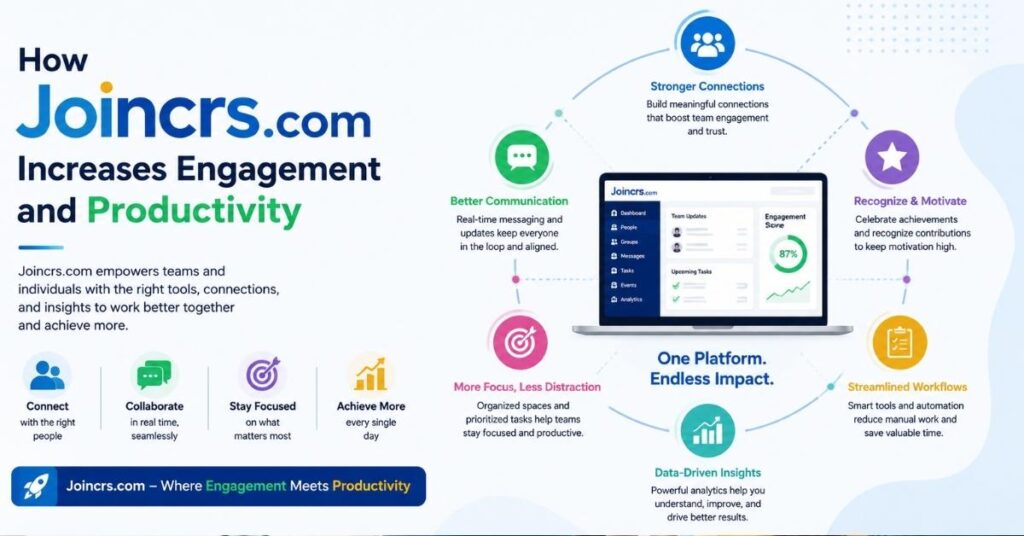
When friction drops, participation tends to climb. Anonymous polling alone has been linked to better retention, since students engage more when judgment isn’t part of the equation. Less time spent on logins also means more time spent on the actual lesson, which compounds across a school year into meaningfully more learning time recovered.
Joincrs com for Remote and Hybrid Learning
Hybrid classrooms aren’t a pandemic leftover anymore. They’re just how a lot of American schools and universities run things now, with some students physically present and others joining remote learning from home or another building entirely. This blend of hybrid education and online education has become one of the more practical school technology solutions available to districts juggling tight budgets and varied student needs.
Joincrs com handles this without needing a separate setup for remote students. The same code that gets a kid in the back row connected also gets a kid logging in from their kitchen table connected, at the same time, inside the same live session. That single detail removes the awkward “two classes happening at once” feeling that plagues a lot of remote education platform setups.
Supporting Online and Blended Classrooms
In a typical hybrid setup, half the class sits in the room while the other half joins through Zoom or Microsoft Teams. Joincrs com layers on top of either video tool without conflict. Remote students answer the same polls, see the same traffic light prompts, and contribute to the same shared whiteboard as everyone else.
That shared experience matters more than it might sound. Remote students in many hybrid learning environment setups report feeling like an afterthought, watching rather than participating. This system closes that gap by making the activity itself, not just the video feed, identical for everyone in the room or out of it.
Practical Classroom Use Cases
A few real scenarios show how this plays out day to day. In an elementary classroom, a teacher might open Monday with a mood check-in widget, watching the room’s overall feeling pop up in under a minute, then adjusting the day’s pace accordingly.
In a middle school science class, a live five-question quiz might reveal that sixty percent of students missed one specific concept. Instead of pushing forward, the teacher pauses right there and reteaches that one piece. That’s one of the better formative assessment tools a teacher can lean on, since it catches gaps while there’s still time to fix them.
In a high school debate class, an anonymous poll on a sensitive topic draws out more honest answers than a show of hands ever would. And in a university hybrid seminar with forty students split between in-room and remote, the same live poll keeps both groups moving together instead of running two separate experiences. None of this requires deep learning management integration either, since the platform sits comfortably alongside whatever LMS a school already runs.
Privacy and Security on Joincrs com
This part deserves real attention, not a quick paragraph and a “trust us.” Schools handle children’s data, and that comes with serious responsibility, especially with COPPA rules tightening in recent years. Anyone evaluating digital education tools for a classroom should read the actual Joincrs com privacy policy before rolling anything out district-wide.
Joincrs com leans into a privacy-first design rather than treating it as an afterthought. Minimal data gets collected in the first place, which sidesteps a lot of the usual risk that comes with storing student profiles long-term.
What Student Data Does Joincrs com Collect?
The honest answer is: barely anything. Students never create accounts, never type in an email address, and never fill out a profile. The only thing tying them to a session is a temporary code that expires once class ends.
That’s a deliberate choice tied to student data privacy. Less data collected means less data that could ever be exposed, lost, or misused. For families nervous about how much information schools gather on their kids, this is one of the more reassuring parts of the whole system.
Read More: Best FIFA World Cup 2026: Complete Guide to Schedule, Host Cities & Match Brackets
Is Joincrs com Safe for Children?
Classroomscreen’s privacy policy explicitly covers joincrs.com, and it states the platform doesn’t sell personal information and doesn’t run advertising. Combined with anonymous-by-default participation, the design leans heavily toward protecting kids rather than monetizing them.
That said, no platform is risk-free just because it claims to be. Schools evaluating any educational technology platform should still read the actual privacy policy, check it against COPPA requirements, and confirm how long any data, even minimal data, gets retained after a session ends.
Is Joincrs com GDPR Compliant?
For schools with international students or families based in the EU or UK, GDPR alignment matters too. Because the platform avoids collecting personal identifiers from students in the first place, it naturally sidesteps a lot of GDPR’s stricter requirements around consent and data handling.
Administrators should still confirm this directly with Classroomscreen’s official documentation before rolling things out district-wide, especially if the school serves a global student population.
Pricing and Subscription Options
Cost tends to be the first question any school budget committee asks, and the answer here is refreshingly simple on one side and tiered on the other.
Is Joincrs com Free?
Yes, completely free for students. There’s no paywall standing between a kid and joining a live session. That access point stays open regardless of what plan their teacher or school has signed up for.
Teachers, though, choose between a free version of Classroomscreen and a paid Pro tier. The free plan covers the basics well: live sessions, common widgets, and the core classroom engagement software experience most teachers need day to day.
What Features Require a Classroomscreen Pro Subscription?
| Feature | Free Plan | Pro Plan |
| Live sessions | Yes | Yes |
| Basic widgets | Yes | Yes |
| Saved screens | No | Yes |
| Unlimited sessions | Limited | Yes |
| Advanced customization | No | Yes |
| Detailed analytics | No | Yes |
| School-wide licensing | No | Yes |
Pro unlocks the ability to save and reuse screens, run sessions without limits, dig into detailed analytics on student performance, and access school-wide licensing with centralized billing. For a single classroom teacher just running quick polls, free often does the job fine. For a department or whole school wanting consistency and deeper data, Pro starts making more sense.
Common Problems and Troubleshooting
Even the simplest tools hit snags sometimes, and Joincrs com is no exception. This Joincrs com troubleshooting section covers the handful of causes behind most issues, which makes fixing things fairly quick once you know what to check.
Why Can’t a Student Join a Session?
The most common culprit is a wrong or expired code. Codes tied to a session stop working once that session ends, so a code from yesterday’s class won’t get anyone into today’s lesson. Beyond that, school network filters sometimes block access, and outdated browsers occasionally choke on the page.
A quick mental checklist solves most cases fast. Double-check the code matches exactly what the teacher is showing right now. Confirm the internet connection is actually working. And make sure the browser isn’t several years out of date.
What Happens If a Student Loses the Session Code?
Nothing dramatic. The teacher just shares it again, out loud, on the projector, or through a quick QR code refresh. If a student already joined and accidentally closed their browser tab, re-entering the same code brings them right back into the live session, no progress lost, as long as the session is still active.
How to Fix Common Access Issues
Most fixes take under a minute. Refresh the page and retype the code carefully. Switch to a different browser if one seems to be misbehaving. Ask the school’s IT contact if a network filter might be blocking joincrs.com specifically, since that does happen occasionally on tightly locked-down school networks.
Practical Tips for Getting the Most Out of Joincrs com
A few small habits separate teachers who use this tool well from teachers who use it just okay. None of these tips require extra training, just a bit of intention.
Best Practices for Teachers
Set session codes to expire right after class ends, since that’s a simple security habit that keeps uninvited guests out of a live session. Lean on QR codes for younger students who might struggle typing six digits accurately. Pair a quick poll at the start of class with a traffic light check at the end, which together paint a fuller picture of where students stand. And if part of the class joins remotely, post the shared link in Google Classroom or Canvas before the bell rings, so remote students are ready the second the session goes live.
Tips for Improving Student Participation
Encourage students to bookmark joincrs.com ahead of time rather than scrambling to find it mid-lesson. Lean into anonymous polling especially for topics where kids tend to clam up, since that anonymity tends to unlock more honest answers. And make the traffic light check a regular routine rather than a rare event, since familiarity breeds comfort, and comfort breeds actual participation.
Joincrs com vs Other Classroom Engagement Platforms
No platform exists in a vacuum, and it helps to know where Joincrs com sits next to other tools teachers might already recognize.
What’s the Difference Between Joincrs com and Kahoot?
Kahoot runs as a standalone gamified quiz platform, and it usually asks for some kind of account setup on both ends. Joincrs com, by contrast, skips accounts entirely and connects to Classroomscreen’s wider toolkit of polls, timers, and feedback widgets rather than focusing purely on game-style quizzes.
| Feature | Joincrs com | Kahoot |
| Account required | No | Often yes |
| Focus | Broad classroom engagement | Gamified quizzes |
| Setup time | Seconds | A few minutes |
| Best for | Daily classroom checks | Quiz-style review games |
Neither tool is objectively “better.” They solve slightly different problems. Kahoot leans into competition and game energy. Joincrs com leans into speed and everyday classroom routine.
Where Joincrs com Fits in the Modern EdTech Ecosystem
The broader education technology market is crowded, and a lot of tools try to do everything at once, often badly. Joincrs com stays narrow on purpose. It’s not trying to replace a school’s LMS, and it’s not pretending to be a gradebook.
Instead, it slots in as the real-time classroom interaction layer sitting on top of whatever a school already uses, whether that’s Google Classroom, Canvas, Schoology, or Moodle. That kind of focused positioning tends to age well, since schools rarely want to rip out existing systems just to adopt something new.
Read More: FIFA World Cup Brackets 2026: Complete Tournament Bracket, Schedule & Predictions
User Reviews and Community Feedback
Any honest Joincrs com review points to the same handful of things teachers mention over and over, and those patterns are worth paying attention to.
What Teachers Like About Joincrs com
The recurring theme is speed paired with simplicity. Teachers consistently point to less time spent troubleshooting logins, smoother starts to class, and the comfort of knowing the tool works no matter what device a student happens to be holding that day. One teacher summed it up simply: “I stopped dreading the first five minutes of class once logins stopped being a thing.”
Success Stories and Real Classroom Experiences
A common pattern shows up across grade levels: teachers who introduce traffic light check-ins early in the year find students naturally fall into the habit, using it without prompting by midyear. Another pattern involves shy students who rarely spoke up in class discussions suddenly contributing real answers once anonymous polling entered the rotation. These aren’t miracle transformations, just steady, believable shifts that come from removing friction and adding a low-pressure way to participate.
Frequently Asked Questions
What Is Joincrs com Used For?
It’s used to let students join live, teacher-led classroom sessions on Classroomscreen. Students answer polls, take quizzes, and give feedback in real time, all without needing an account.
Is Joincrs com the Same as Classroomscreen?
Not exactly. Classroomscreen is the full teacher platform used to build and run lessons. Joincrs.com is the specific student entry point used to join those sessions.
Does a Student Need an Account to Use Joincrs com?
No. Students just enter a six-digit code given by their teacher. No sign-up, no password, no profile required.
Can Students Use Joincrs com on a Phone or Tablet?
Yes. The platform works on any modern browser, including phones, tablets, laptops, and Chromebooks.
Is Joincrs com Free?
Yes, for students it’s always free. Teachers can choose between a free Classroomscreen plan or a paid Pro subscription for advanced features.
Is Joincrs com Safe for Children?
The platform collects minimal data, runs no ads, and supports anonymous participation by default, which lines up well with privacy expectations for school-age users.
What Happens If a Student Loses the Session Code?
The teacher simply shares it again. As long as the session is still live, re-entering the code brings the student right back in.
What’s the Difference Between Joincrs com and Kahoot?
Kahoot is a standalone gamified quiz app that usually needs accounts. Joincrs com skips accounts and connects to a broader set of classroom engagement tools rather than focusing only on game-style quizzes.
Conclusion
Back to that 8:58 a.m. scramble from the start of this guide. That’s the exact moment Joincrs com quietly fixes. One website. One short code. No passwords to forget, no apps to install, no IT ticket to file. Just a fast, simple way to get every student, whether they’re sitting in the front row or joining from home, into the same live lesson at the same time.
For teachers, that means less energy spent on logistics and more spent on actual teaching, backed by real-time data on who’s keeping up and who needs help right now. For students, it means walking into class without friction or embarrassment, with a fair shot to participate whether they’re shy, tech-savvy, or somewhere in between. And for schools weighing privacy concerns, it offers a refreshingly minimal approach to student data, built around the idea that less collected is less to worry about.