

The Ultimate Guide to 9 Curly Hair Types (With Chart & 10 Care Tips)
Curly hair is stunning. But standing in the hair care aisle, staring at a hundred products, wondering what is my hair type that’s a different story. It’s confusing, overwhelming, and honestly a little exhausting. Here’s the good news: once you understand your curly hair types, everything clicks. The right products find you. Your routine gets simpler. Your curls? They thrive.
This guide covers everything the hair type chart, the curl classification system, care routines, product picks, and the mistakes quietly ruining your curls. Whether you’re rocking loose beach waves or tight 4C coils, you’ll find exactly what you need right here.
What Are the Different Curly Hair Types?
The modern hair typing system traces back to celebrity hairstylist Andre Walker, who created a curl classification system that organizes hair texture types into four main categories Type 1 through Type 4. Type 1 is straight. Types 2, 3, and 4 cover the full natural hair texture guide from waves to coils. Each type splits further into A, B, and C subtypes based on curl tightness and texture. Think of it like a spectrum not a rigid box you must squeeze into.
Understanding different hair types explained through this system matters more than most people realize. Your curl pattern types determine how much moisture your hair needs, which products work, and how your strands behave in humidity. Two people can both call themselves “curly” and need completely opposite routines. That’s exactly why the hair categories chart exists to help you stop guessing and start caring for your hair with precision.
How Many Hair Types Are There?
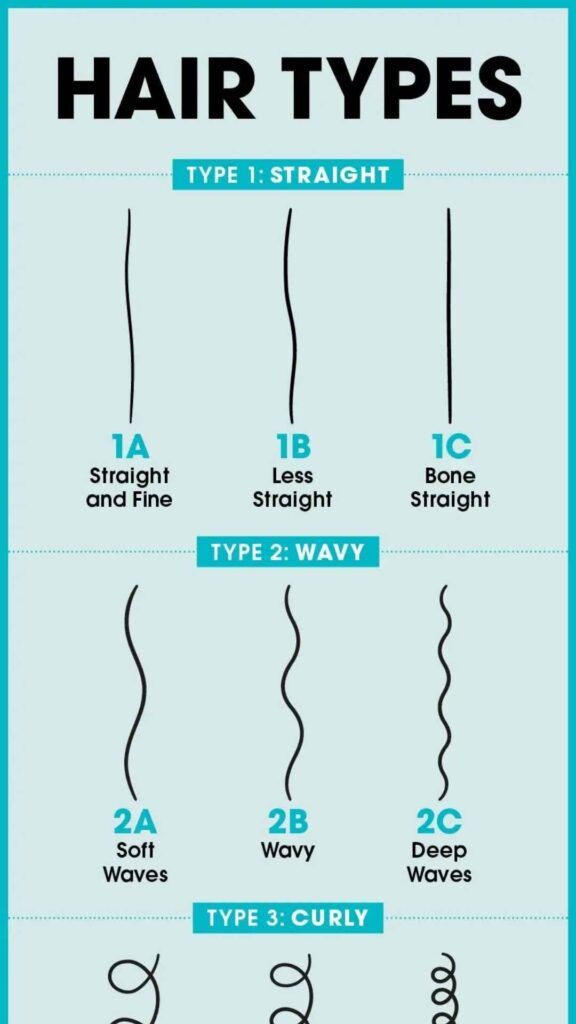
There are 12 subtypes total across 4 main hair structure types. Types 2A through 4C cover every natural curl pattern you’ll encounter. It sounds like a lot but the system is intuitive once you see it. The number tells you the broad category wavy, curly, or coily. The letter tells you the intensity A being the loosest, C being the tightest within that group.
Most people discover they don’t fit perfectly into one subtype. You might have type 3 curly hair at your nape and looser waves at your crown. That’s completely normal. Hair density and texture vary across different sections of the same head. Your dominant type the one that shows up most is your starting point for building a routine.
| Hair Type | Category | Pattern Description |
| 2A | Wavy | Loose, fine S-waves |
| 2B | Wavy | Defined S-waves, medium texture |
| 2C | Wavy | Strong waves, frizz-prone |
| 3A | Curly | Large, loose spirals |
| 3B | Curly | Springy ringlets, more volume |
| 3C | Curly | Tight corkscrews, dense |
| 4A | Coily | Soft, defined S-coils |
| 4B | Coily | Z-shaped bends, fragile |
| 4C | Coily | Tightest coils, max shrinkage |
What Is a Hair Type Chart?
A hair type chart is a visual tool that maps every curl pattern identification from straight to tightly coiled. Hairstylists and trichologists use it as a diagnostic starting point. For everyday people, it’s a mirror that finally shows you what your hair actually is not what the shampoo bottle thinks it is. The chart groups textures by their visual appearance on dry, product-free hair.
Using a curl types chart at home is simpler than it sounds. You wash your hair, let it air dry completely, then compare your natural pattern to the chart images. The key is clean hair with zero product influence. Humidity, product buildup, and heat styling all mask your true natural curl pattern so starting fresh gives you the most honest read.
Curly Hair Types Chart Explained (2A–4C Guide)
This is the heart of the curly hair guide for beginners. Each subtype below describes what the curl looks like, feels like, and needs. Scan to your type and read carefully this section alone will change how you approach your routine.
Wavy Hair (2A, 2B, 2C)
Wavy hair characteristics are defined by a gentle S-bend that forms without much product or effort. 2A hair is the loosest fine, floppy waves that fall flat at the roots by midday. 2B hair brings more definition, with waves that hold their shape longer but still surrender to humidity fast. 2C hair sits right on the border between wavy and curly strong, bold waves with a tendency toward serious frizz, especially in the American South’s humidity. If your hair dries in an S-shape but never fully coils into a spiral, you’re almost certainly a type 2 hair person. The key giveaway? Roots that go flat while the ends wave.
Wavy hair is the most fine-textured of the three curl families. It absorbs products quickly but also gets weighed down fast. A heavy cream meant for type 4 coily hair will completely flatten a 2A wave. Light, flexible products are your best friends here. How to care for wavy hair starts with one rule: less is more. Use lightweight products, don’t skip the scrunch, and resist the urge to brush your waves when dry that’s how frizz wins.
Curly Hair (3A, 3B, 3C)
Curly hair characteristics center on defined, springy spirals that bounce back when you stretch them. 3A hair has large, loose ringlets about the width of a sidewalk chalk piece shiny, easy to elongate, and the most forgiving of Type 3. 3B hair tightens things up into medium ringlets with impressive volume and noticeable shrinkage when it dries. 3C hair is the tightest of the curly family dense corkscrew curls packed closely together, with significant shrinkage that can make shoulder-length hair look much shorter. Understanding the difference between type 2 3 and 4 hair starts here: Type 3 curls actually coil, they don’t just wave.
Type 3 curly hair needs consistent moisture and gentle handling. The best routine for type 3 hair includes a co-wash or low-poo cleanser, a rich leave-in conditioner, and a curl cream applied on soaking wet hair. The LOC method Liquid, Oil, Cream is a game-changer for this type. Shrinkage is real and normal. Your 3C curls might look mid-back length when wet and rest at your shoulders when dry. That’s not damage that’s curl shrinkage doing exactly what it’s supposed to do.
Coily/Kinky Hair (4A, 4B, 4C)
Coily kinky hair is the most textured, the most fragile, and when properly cared for the most spectacular of all curly hair types. 4A hair forms soft, tight S-coils about the width of a knitting needle. It retains moisture better than 4B and 4C and often shows visible curl definition without much product effort.
4B hair bends in sharp Z-shapes rather than soft spirals each bend is a structural weak point, making this type prone to breakage without the right care. 4C hair is the tightest of them all coils so small they’re barely visible without product, with shrinkage that can reach 75% of the hair’s actual length. Long 4C hair often looks much shorter than it is. That’s not a problem to fix. That’s texture magic.
How to manage type 4 hair comes down to three priorities: moisture, protection, and gentle handling. Coily hair is naturally dry because natural oils from the scalp struggle to travel down such tightly coiled strands. How to moisturize coily hair effectively means layering products using the LCO method Liquid, Cream, Oil sealing every layer before adding the next. Protective styles like twists, braids, and buns give type 4 coily hair a break from daily manipulation and support length retention. This hair type doesn’t need more products it needs the right products, applied consistently.
How to Identify Your Curly Hair Type (Step-by-Step)
How to identify curly hair type at home doesn’t require a salon visit or a professional consultation. You just need clean hair, patience, and good lighting. The hair type test at home works best when your hair is completely free of styling products, heat damage disguise, and braiding tension. Start fresh and let your natural texture speak for itself.
How to find your curl pattern follows a clean, repeatable process. First, wash with a clarifying shampoo to strip all buildup. Then apply a lightweight conditioner, rinse thoroughly, and let your hair air dry completely hands off, no diffuser, no touching. Once fully dry, look at your mid-shaft (not roots, not ends) and compare your natural pattern against the hair categories chart above. Do this on two or three wash days before deciding humidity and product history can affect results on the first attempt.
Step-by-step curl type identification:
- Clarify with a sulfate-based shampoo one time only
- Apply lightweight conditioner from mid-shaft to ends
- Rinse fully with cool water
- Gently squeeze out excess water don’t rub or twist
- Air dry completely this takes 2 to 6 hours depending on thickness
- Examine the pattern at mid-shaft in natural daylight
- Compare to the curl types chart and identify your dominant type
Signs You Have Wavy vs Curly vs Coily Hair
Not sure where you land? Your hair sends clear signals if you know what to look for. Wavy hair dries with a loose bend, falls flat at the roots within a few hours, and responds dramatically to humidity going from defined waves to a frizzy halo fast. It rarely forms a true spiral. Curly hair bounces back when you stretch it, forms defined rings or spirals without much product, and has noticeable shrinkage between wet and dry states.
Coily hair is the most visually distinct. It forms tight, dense coils or sharp Z-bends, feels dryer than other types because oil doesn’t travel easily down the strand, and shrinks dramatically sometimes 50 to 75% of its wet length. The table below makes wavy vs curly hair comparison fast and clear.
| Feature | Wavy (Type 2) | Curly (Type 3) | Coily (Type 4) |
| Pattern | S-wave | Spiral/Ringlet | Tight coil/Z-bend |
| Shrinkage | Minimal | Moderate | High (up to 75%) |
| Frizz Risk | Low–Medium | Medium–High | High |
| Moisture Need | Light | Moderate | Heavy |
| Natural Shine | High | Moderate | Low (absorbs light) |
| Fragility | Low | Medium | High |
Wet vs Dry Hair Testing Method
The wet hair test shows your curl’s maximum potential the pattern your hair wants to form when fully hydrated. Fresh out of the shower, your curls are at their most defined and elongated. The dry hair test shows reality how your curls actually behave in daily life, with full shrinkage and natural texture on display. Both tests tell you something important. Wet results help you pick styling products. Dry results help you understand shrinkage, volume, and frizz patterns.
Smart tip: run both tests on the same wash day. After your shower, photograph your wet pattern at mid-shaft. Then let it air dry fully and photograph again. Comparing the two images is one of the fastest ways to understand your curl pattern identification and it’ll explain a lot about why certain products have been failing you.
Key Differences Between Wavy, Curly, and Coily Hair
Wavy vs Curly Hair Differences
The biggest wavy vs curly hair difference isn’t just visual it’s structural. Wavy hair tends to have a rounder strand cross-section, which means natural oils can travel down the shaft more easily. That’s why type 2 hair often looks shinier and feels less dry than type 3 curly hair.
Curly hair has an oval cross-section oil gets stuck navigating the spirals. Product absorption also differs significantly. Wavy hair resists heavy creams, while curly hair drinks them up. Using the wrong product weight is the fastest way to ruin a wash day for either type.
How to style curly hair types across this divide requires one foundational shift in thinking: match your product weight to your curl tightness. Wavy hair needs mousses and sprays. Curly hair needs creams and gels. Mixing them up using a heavy butter on 2B waves, for example leads to limp, greasy results that no amount of diffusing will fix. Curly hair maintenance tips for both types always begin with this: use what your curl density actually needs, not what the front label promises.
Curly vs Coily Hair Explained
Curly vs coily comes down to fragility and moisture. Type 3 curly hair handles daily manipulation reasonably well it can be detangled, styled, and refreshed without extreme risk of breakage. Type 4 coily hair is a different story entirely. Every sharp Z-bend in a 4B or 4C strand is a structural weak point. Aggressive detangling, skipping moisture, or using drying products causes breakage that quietly steals your length over months without you noticing.
Coily hair types demand the most intentional care of any natural hair texture guide category. Detangling must happen on wet, slippery hair never dry. Protective styles aren’t optional extras; they’re length-retention tools. How to treat curly hair naturally at the coily end of the spectrum means embracing a simple truth: this hair type rewards patience and punishes rush. Give it moisture, give it time, and it gives you length, volume, and undeniable presence.
Best Hair Care Routine for Each Curly Hair Type
A curly hair care routine step by step looks completely different depending on where you fall on the curl pattern types spectrum. The cleanser that works beautifully for type 2 hair can strip a 4C scalp bare. The butter that keeps coily hair soft will flatten wavy hair instantly. Building the right routine means starting with your type and working outward from there.
The single biggest mistake in curly hair routine for beginners is copying someone else’s routine without checking their curl type. Influencers with 3A curls and influencers with 4C coils both use the word “curly” but their hair needs are worlds apart. Curly hair problems and solutions almost always trace back to a mismatched routine. Once you build one that fits your specific curl classification system category, the results speak for themselves.
Read More About: Best Hair Braiding: Complete Beginner Guide + 25 Braid Hairstyles for Women
Routine for Type 2 Wavy Hair
Type 2 hair needs balance. Wash 2 to 3 times a week with a gentle, sulfate-free shampoo that cleanses without stripping. Follow with a lightweight conditioner applied from the ears down avoid the roots to prevent that flat, greasy wave look. On wet hair, apply a small amount of curl-enhancing mousse or a light wave spray, then scrunch upward toward the scalp. Let it air dry or diffuse on low heat. The golden rule of how to care for wavy hair is simple: don’t touch it while it dries. Every finger-comb or hair flip while wet breaks up wave formation and invites frizz.
How to reduce frizz in curly hair for type 2 specifically starts with the ingredients you’re avoiding. Silicones coat the hair shaft and cause buildup that makes waves look dull and greasy. Heavy alcohols dry the strand, causing frizz. Look for aloe vera, flaxseed, and hydrolyzed wheat protein in your products these enhance wave definition without the baggage. A microfiber towel or an old cotton T-shirt for drying replaces terrycloth, which agitates the hair shaft and creates friction-based frizz.
Routine for Type 3 Curly Hair
Type 3 curly hair thrives on moisture and consistency. Co-wash or use a low-poo shampoo 1 to 2 times per week this preserves the natural oils your curls need for definition and shine. Deep condition every 7 to 14 days without exception. Curl hydration isn’t a luxury for type 3 hair it’s a biological requirement. After washing, apply a leave-in conditioner on soaking wet hair, followed immediately by a curl cream.
The LOC method sequences these steps Liquid (water or leave-in), Oil (light sealing oil), Cream (curl cream or butter) for maximum moisture retention.
Best routine for type 3 hair wraps up with a plopping step: lay a microfiber towel flat, flip your wet hair onto it, wrap and secure for 20 to 30 minutes. This removes excess water without disrupting curl formation. Then diffuse on low heat or air dry. The result? Defined, bouncy spirals with minimal frizz.
How to keep curls defined and healthy at the Type 3 level also means regular protein treatments every 4 to 6 weeks protein fills in damaged areas of the cuticle and restores snap and elasticity to stretched-out spirals.
Routine for Type 4 Coily Hair
How to manage type 4 hair starts with washing frequency once a week or every 10 days is enough for most type 4 coily hair people. Overwashing destroys the delicate moisture balance coily strands work hard to maintain. Use a moisturizing, sulfate-free shampoo or a gentle cleansing conditioner.
Always detangle on wet, conditioned hair with a wide-tooth comb or your fingers — starting from the ends and working upward. Never detangle dry coily hair types. The breakage that results is silent, cumulative, and devastating to length.
How to moisturize coily hair effectively relies on the LCO method Liquid (water-based leave-in), Cream (thick moisturizing cream), Oil (heavy sealing oil like castor or jamaican black castor oil). This sequence traps moisture inside the strand and prevents the rapid moisture loss that makes 4B and 4C hair feel dry within hours of washing. Protective styles twists, braids, buns give your ends a break from daily exposure and manipulation. Seal your ends with a heavy butter every few days. Curly hair problems and solutions for Type 4 almost always resolve when moisture and protection become non-negotiables, not afterthoughts.
Best Products for Each Curl Type (Expert Picks)
Products for wavy curly coily hair are not interchangeable and the beauty industry’s one-size-fits-all marketing has confused a lot of people. Best products for curly hair types are always matched to texture, porosity, and density. Here’s what actually works across all three families, based on widely recommended formulations in the curly hair community.
The curly hair guide for beginners rule for products: start with one new product at a time. Adding three new things to your routine at once makes it impossible to know what’s working and what isn’t. Introduce changes slowly, give each product 3 to 4 wash days before judging it, and always consider your hair porosity and texture before buying.
Styling Products for Wavy Hair
Wavy hair products should be lightweight, flexible, and humidity-resistant. Mousses, light hold gels, and curl-enhancing sprays are the go-to formats. Look for aloe vera, hydrolyzed wheat protein, and flaxseed extract in the ingredient list these strengthen and define without weighing waves down.
Sea salt sprays add texture and enhance the natural wave pattern beautifully for 2A and 2B types, though they can be drying for 2C waves that already lean dry. Not Your Mother’s Curl Talk Mousse and Cantu Wave Whip Curling Mousse are widely praised, budget-friendly picks for type 2 hair across the USA.
How to style curly hair types at the wavy end means applying products to soaking wet hair, scrunching upward, and leaving it alone. Product performance improves when hair is wetter than you think it needs to be. The common mistake is applying mousse to damp hair — by then, curl formation has already been compromised and the product just coats the outside of a partially dried wave.
Curl Creams & Gels for Type 3 Hair
Type 3 curly hair responds best to mid-weight curl creams and flexible-hold gels. You want glycerin, shea butter, and coconut oil at the top of the ingredient list these hydrate, define, and add that healthy-looking shine characteristic of well-moisturized spirals.
Gel applied over a curl cream gives hold without crunch when you scrunch out the cast once the hair is fully dry this technique is called “scrunching out the crunch” (SOTC) and it’s a game-changer. SheaMoisture Coconut & Hibiscus Curl Enhancing Smoothie is a bestseller for a reason. Kinky-Curly Knot Today Leave-In works brilliantly as the Liquid step in the LOC method for 3B and 3C curls.
How to keep curls defined and healthy with products also means knowing when to clarify. Even the best curl cream causes buildup over time especially glycerin-heavy formulas. A monthly clarifying wash resets the slate and lets your products penetrate properly again instead of sitting on top of last week’s product layer.
Moisturizers for Type 4 Coily Hair
Coily hair types need the heaviest, richest formulations in the hair texture types world. Think thick creams, heavy butters, and sealing oils that create a genuine moisture barrier on the strand. Castor oil, mango butter, avocado oil, and shea butter are the gold-standard ingredients for type 4 coily hair moisture.
Mielle Organics Rosemary Mint Strengthening Leave-In Conditioner is a community favorite for its combination of moisture and scalp-stimulating benefits. Jamaican Black Castor Oil as a sealant has decades of use in the Black American hair community for good reason it’s heavy, nourishing, and effective.
How to moisturize coily hair daily without a full wash means using the “refresh” method: lightly spray sections with water, apply a small amount of leave-in conditioner, and seal with your oil of choice. This keeps 4C hair moisturized between wash days without causing product overload. Curly hair maintenance tips for Type 4 also include satin bonnets or pillowcases at night cotton pillowcases absorb moisture from your hair while you sleep, undoing hours of careful moisturizing.
Common Mistakes to Avoid for Curly Hair Types
Curly hair problems and solutions often trace back to two root causes: washing habits and product choices. Getting these two things right fixes about 80% of the complaints curly-haired people bring to their stylists. The good news is both are entirely within your control once you understand what’s actually happening at the strand level.
Curly hair maintenance tips always start with honest self-assessment. Are your curls dry, limp, frizzy, or losing definition faster than they should? The answer usually points directly to one of the two mistakes below. Identify which one applies to your routine or whether both do and start there.
Overwashing & Product Buildup
Washing curly hair types too frequently strips the scalp of natural sebum the oil your body produces to naturally moisturize and protect your strands. For straight hair, daily washing is manageable because oil travels down the shaft easily.
For curly and coily hair, that oil barely makes it past the first curl which means washing it away leaves the hair defenseless. Product buildup compounds the problem. Silicone-heavy conditioners and styling products coat the strand with each use, eventually creating a barrier that blocks moisture from getting in. Your hair starts feeling dry no matter how much conditioner you use and that’s because conditioner can’t penetrate a silicone seal.
The solution is a two-part approach. First, reduce wash frequency to what your specific curl pattern types actually need 2 to 3 times weekly for wavy, 1 to 2 times for curly, weekly for coily. Second, clarify monthly with a genuine clarifying shampoo to strip silicone and mineral buildup. Between washes, co-wash with a silicone-free conditioner. This keeps your natural curl pattern clean without destroying the moisture balance your curls depend on.
Read More About: Chocolate Brown Hair: 35 Stunning Color Ideas, Shades & Styling Guide (2026)
Using the Wrong Styling Products
A product designed for type 4 coily hair will flatten type 2 wavy hair completely. A mousse designed for wavy hair characteristics will provide zero moisture to 4C coils. Using the wrong product weight is the most common reason people believe curly hair is “difficult.” It isn’t difficult — it’s just specific. Curl-friendly products matched to your actual curl classification system category perform dramatically better than premium products chosen by marketing alone.
Beyond product weight, ingredient awareness matters enormously. Drying alcohols like SD alcohol, alcohol denat, and isopropyl alcohol appear in many drugstore styling products and actively dehydrate your strands. Heavy silicones like dimethicone cause buildip that suffocates your curl pattern.
Sulfates in high concentrations strip oils aggressively. On the positive side, glycerin, aloe vera, panthenol, and hydrolyzed proteins are universally beneficial across all curly hair types and actively support how to keep curls defined and healthy over time.
How Hair Porosity Affects Curly Hair Types
Hair porosity and texture are inseparable conversation partners. You can know your curl pattern identification perfectly but still pick the wrong products if you don’t understand porosity.
Hair porosity describes how easily your hair absorbs and retains moisture determined by the state of your cuticle layer. Flat, tightly sealed cuticles = low porosity. Raised, gapped cuticles = high porosity. Neither is better or worse they just need different approaches.
The float test is the simplest hair type test at home for porosity. Drop a clean, dry strand into a glass of room-temperature water. If it floats after 2 to 4 minutes, you have low porosity hair. If it sinks slowly, you have normal porosity. If it sinks fast, you have high porosity hair. Run this test after a clarifying wash for the most accurate result product coating changes how the strand interacts with water.
Low vs High Porosity Explained
Low porosity hair has tightly sealed cuticles that resist moisture entry. Water beads off the surface, products sit on top rather than absorbing, and it takes a long time to get fully saturated in the shower.
The fix is gentle heat a warm deep conditioning session, a steamer, or even wrapping your head in a warm towel opens the cuticle temporarily and lets moisture in. Once moisture gets inside low porosity hair, though, it tends to stay there making this type less prone to dryness than high porosity hair once properly moisturized.
High porosity hair absorbs moisture fast but loses it just as quickly. The cuticle gaps that let water rush in also let it evaporate right back out. This is often the result of heat damage, chemical processing, color treatments, or simply genetics particularly common in type 4 coily hair naturally. Protein treatments every 4 to 6 weeks fill in the cuticle gaps and restore the hair’s ability to retain moisture. Heavy sealants butters, castor oil applied as the final step in any routine lock moisture inside the strand before it can escape.
Matching Products to Porosity
| Porosity Type | Best Product Types | Key Ingredients | Avoid |
| Low Porosity | Lightweight, water-based | Aloe vera, glycerin, honey | Heavy butters, protein overload |
| Normal Porosity | Balanced creams and gels | Shea butter, coconut oil | Harsh sulfates |
| High Porosity | Rich butters, protein treatments | Castor oil, keratin, mango butter | Drying alcohols, silicones |
Matching products to hair porosity and texture is the single biggest upgrade most people overlook. Two people with identical type 3B curls can need completely different products based on their porosity alone. Porosity-matched products hydrate efficiently, reduce frizz, and maintain curl definition far longer than generic curl products chosen without this context. This is how to treat curly hair naturally in the most effective, science-backed way work with your hair’s actual structure, not against it.
FAQ’s
What are the 4 types of curly hair?
The four main hair structure types in the hair typing system are Type 1 (straight), Type 2 (wavy), Type 3 (curly), and Type 4 (coily/kinky). Within the curly and wavy categories the ones most relevant to this guide there are nine subtypes total: 2A, 2B, 2C, 3A, 3B, 3C, 4A, 4B, and 4C. Each subtype describes a progressively tighter curl pattern within its category.
How do I know my curl type?
How to identify curly hair type at home starts with a clarifying wash, a light condition, and a full air dry no products, no diffusing, no touching. Once dry, compare your mid-shaft pattern to a curl types chart. The hair type test at home works best repeated over 2 to 3 wash days, since humidity and residual product can affect results on a single test.
Can you have more than one curl type?
Absolutely and most people do. Having type 2C waves at the crown and type 3A spirals at the nape is incredibly common. This is called multi-textured hair. How to find your curl pattern in this case means identifying your dominant type and building your routine around it, while using flexible product choices that work across the range of textures on your head.
Conclusion
Knowing your curly hair types isn’t about putting yourself in a box. It’s about understanding your hair well enough to give it exactly what it needs nothing more, nothing less. The hair type chart is your roadmap. Your curl pattern identification is your starting point. Your porosity, density, and texture fill in the details.Build your routine around your type. Match your products to your hair porosity and texture.
Stop borrowing routines designed for different curl classification system categories and watch what happens when you finally give your specific curls the specific care they’ve been asking for. Your curls have been doing their best with whatever you’ve been giving them. Imagine what they’ll do when you give them exactly what they need. That’s the whole point of this curly hair guide for beginners and every curl type in between.


