
Xendit Gamification Summit Work: 11 Complete Guide to Its Strategy and Impact
Xendit Gamification Summit Work is changing how modern companies think about employee engagement and workplace productivity. This framework combines gamification mechanics, smart technology, and human-centered design into one powerful internal system. Companies across Southeast Asia and beyond are paying close attention and for good reason.
The way people work has changed dramatically. Hybrid work culture created flexibility but also emotional distance. Employees finish tasks without feeling connected to the mission. That quiet disconnection costs companies more than most leaders realize. Understanding how Xendit built a solution to this problem gives every organization a practical roadmap worth studying.
What Is Xendit Gamification Summit Work?
Xendit Gamification Summit Work is an internal employee engagement platform developed by Xendit, a leading fintech company based in Southeast Asia. It blends workplace gamification, performance tracking, and team collaboration into a single connected system that makes everyday work feel rewarding and visible.
This isn’t a simple points system or a flashy leaderboard experiment. It’s a full motivation framework built around behavioral psychology, digital rewards, and measurable employee experience management. The program supports workforce engagement by turning meaningful contributions into celebrated milestones not just metrics on a spreadsheet.
Why Xendit Created the Gamification Summit Program
Xendit noticed something concerning beneath strong productivity reports. Employee morale was quietly dropping across departments. Teams were delivering results but losing their emotional connection to the company’s larger mission.
Leadership recognized this wasn’t a performance problem. It was a deeper employee experience crisis tied directly to the realities of modern digital workplace culture. So they built an internal engagement program designed to restore that connection at scale.
The Challenge of Traditional Employee Engagement
Traditional employee recognition programs rely on annual reviews, one-time bonuses, and generic surveys. Those tools worked when everyone sat in the same office. However, hybrid work culture made emotional disconnection the norm rather than the exception. Employee burnout grew quietly while productivity numbers stayed stable a dangerous gap that standard human resources playbooks rarely caught early enough.
Goals Behind the Initiative
The core goal was simple but ambitious: make employees feel genuinely connected to progress, peers, and purpose every single day. Xendit wanted to improve cross-functional collaboration, increase employee participation in company initiatives, and reduce hidden burnout through consistent positive reinforcement. The Gamification Summit framework gave those goals a structured, measurable path forward.
How the Xendit Gamification Framework Works
The framework operates through carefully layered gamification mechanics that reward meaningful behavior not busy work. Every element connects to real job responsibilities. That alignment is what separates this system from gimmicky corporate gamification experiments.
Employees move through a progression system that combines achievement badges, collaborative quests, seasonal leaderboards, and AI-powered recommendations into one seamless experience. The design respects autonomy while encouraging consistent team participation and professional development.
Daily Wins and Progress Tracking
Daily wins give employees small, manageable goals tied directly to their actual work. Completing one meaningful challenge per day builds workforce motivation through consistent momentum. The real-time dashboard makes every milestone instantly visible. That visibility alone creates a psychological reinforcement loop that keeps employee involvement high without adding pressure.
Collaborative Quests and Team Challenges
Collaborative quests bring cross-departmental teams together around shared goals. A marketing team in Jakarta might partner with an operations group in Manila to complete a team challenge over two weeks. These shared experiences improve workplace communication naturally. They also build workplace belonging something no amount of Slack messages can fully replicate.
Rewards, Recognition, and Motivation Systems
The recognition system inside this framework goes far beyond a “good job” email. Employees earn digital rewards, redeem points for digital vouchers or cashback rewards, and receive visible public recognition through the performance dashboard. That combination of reward fulfillment and social acknowledgment addresses both financial motivation and the deeper human need for employee appreciation.
AI-Powered Personalization
AI personalization ensures every employee receives relevant challenges and personalized learning paths based on their role, behavior, and history. An operations manager gets different smart recommendations than a product developer. This AI-driven engagement approach prevents the fatigue that generic programs create. Predictive engagement insights also help managers spot disengagement patterns before they become serious problems.
Read More: Best Wireless Earbuds of 2026: Tested and Reviewed for Every Need
Key Topics Covered in the Xendit Gamification Summit
The Gamification Summit goes beyond internal initiatives. It functions as a knowledge-sharing event where HR leaders, product managers, developers, and startup founders explore cutting-edge engagement strategy together. Sessions are practical. Attendees walk away with tools they can implement immediately.
Topics range from game-based learning to data analytics and API integration. Every session connects theory to real business outcomes. That focus on applicability makes the summit stand out from typical corporate conferences filled with vague keynotes.
Workplace Gamification Fundamentals
Every attendee starts with a clear foundation in workplace gamification principles. Sessions cover motivational design, achievement systems, progress bars, and leaderboard strategy. Speakers use real case studies like a retail company that saw 45% higher training completion after adding gamified learning to onboarding to ground every concept in measurable reality.
Building Stronger Team Culture
Strong team building doesn’t happen by accident in distributed organizations. The summit explores how challenge-based learning and shared team challenges create genuine workplace connection. Companies learn how to design engagement initiatives that encourage friendly competition without creating toxic pressure or undermining organizational culture.
Learning and Training Through Gamification
Game-based learning dramatically improves training retention. Research consistently shows employees forget up to 70% of new information within 24 hours using traditional methods. Gamified learning changes that equation. The summit dedicates full sessions to learning and development strategies that combine challenge-based learning, badges and rewards, and learning sessions to make training genuinely sticky.
Data-Driven Performance Measurement
You can’t improve employee performance without measuring it accurately. Sessions on data analytics and performance metrics teach companies how to track participation rate, reward redemption, and employee Net Promoter Score (eNPS). Cloud technology and analytics dashboard tools make this data visible in real time giving leaders actionable insight instead of lagging indicators.
Benefits of Xendit Gamification Summit Work
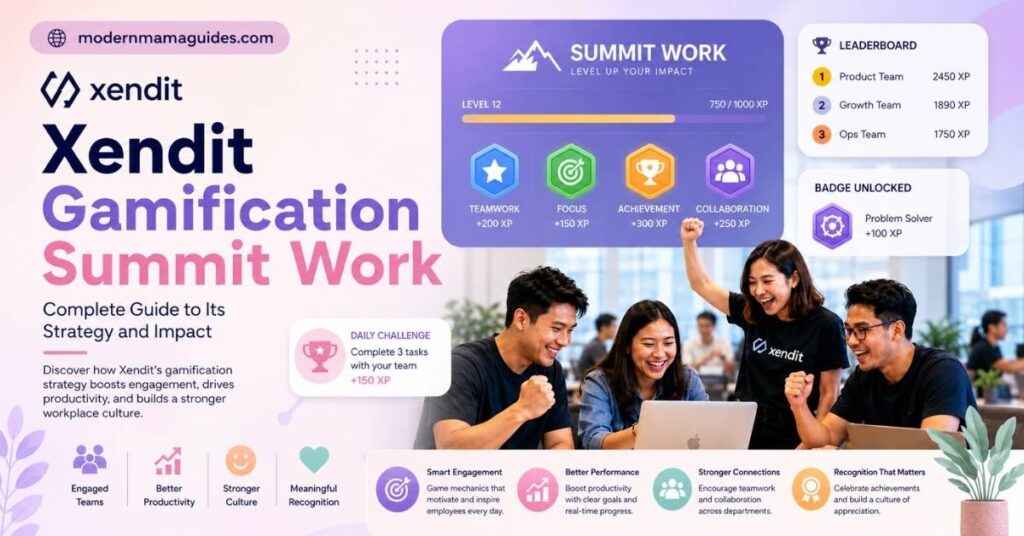
The results of Xendit Gamification Summit Work show up in both hard metrics and human experience. Companies that implement this framework report improvements across workforce engagement, team performance, and employee wellbeing within months not years.
The benefits aren’t limited to large enterprises. Startup founders and mid-sized businesses implementing similar engagement strategy frameworks report equally strong results. The core principles scale surprisingly well across organizations of every size.
| Benefit | Measurable Impact |
| Employee engagement | Higher participation rate in programs |
| Workplace productivity | Faster task completion and performance optimization |
| Learning retention | Up to 45% improvement in training completion |
| Cross-functional collaboration | More active team participation across departments |
| Employee satisfaction | Improved eNPS and retention rate |
Higher Employee Engagement
Employee engagement improves when people can see their progress in real time. The real-time dashboard gives every team member a clear picture of where they stand and what comes next. That clarity eliminates the fog of disconnection that causes workforce engagement to erode. Companies using this framework report consistent increases in participation rate within the first 90 days.
Improved Productivity and Performance
Workplace productivity rises when employees feel their contributions matter. Performance tracking tied to visible goal tracking and reward systems creates a natural motivation loop. Employees complete higher-value work more consistently because the system reinforces behavior that aligns with real business goals not just activity volume.
Better Learning Retention
Gamified learning produces far better retention than traditional training. When employees earn achievement badges for completing modules or advance through personalized learning paths, they stay engaged longer. That sustained attention translates directly into better knowledge retention and faster employee development outcomes across every department.
Stronger Collaboration Across Teams
Collaborative quests force positive interaction between teams that rarely communicate otherwise. A shared mission creates shared identity. Cross-functional collaboration improves naturally when people work toward collective milestones with visible team performance metrics. The social bonds formed during these experiences also strengthen workplace belonging long after the quest ends.
Reduced Burnout and Increased Satisfaction
Employee burnout often builds invisibly until it’s too late. This framework prevents that by creating consistent micro-moments of recognition and progress throughout each workweek. Workplace wellness improves because employees never feel invisible. Seasonal rotations and flexible reward redemption options also prevent the monotony that quietly drains employee happiness over time.
Technology Behind the Gamified Experience
The technology stack powering this system prioritizes simplicity and real-time responsiveness. Cloud-based systems, automation workflows, and mobile accessibility work together to reduce friction and increase adoption across distributed teams.
The platform integrates directly into existing workplace software rather than demanding employees use a separate tool. Data analytics run continuously in the background. Predictive analytics flag disengagement signals early. Smart automation handles routine recognition tasks. That combination creates a digital transformation experience that feels effortless not like another system to manage.
How Xendit Rolled Out the Program Successfully
Xendit launched the program gradually rather than company-wide from day one. That patient approach protected the initiative from the early friction that kills most corporate gamification experiments before they gain traction.
The phased rollout also allowed the team to collect honest feedback before scaling. Employees pointed out weak areas quickly. The team responded fast. That responsiveness built trust and trust is the foundation every internal engagement program needs to survive its first year.
Read More: What Is Team Aelftech com? A Complete Guide to This Modern Digital Marketing Company (2026)
Planning and Framework Design
The design phase involved months of research into behavioral psychology, successful engagement initiatives, and motivational design principles. The team studied what made employee engagement tools fail. They deliberately avoided systems that rewarded meaningless activity or created unfair competition. The result was a motivation framework built around autonomy, progress, and genuine contribution.
Employee Adoption Strategy
Managers participated alongside employees from day one not as observers but as active participants in collaborative quests and team challenges. That decision changed the cultural perception of the program immediately. When leadership visibly engages, employees view the initiative as part of company culture rather than an HR experiment. Onboarding support and clear communication sessions reinforced that message across every department.
Continuous Feedback and Optimization
The program never stopped evolving. Feedback loops ran constantly. Employees reported what felt repetitive, unfair, or confusing. The team adjusted reward systems, scoring criteria, and challenge designs based on real input not assumptions. That cycle of performance optimization through listening is what transformed a good idea into a genuinely effective employee experience management system.
Challenges and Lessons Learned
No engagement initiative launches perfectly. Xendit faced real resistance, real design flaws, and real surprises during the rollout. Acknowledging those challenges honestly is part of what makes this case study so useful for other organizations.
The biggest lesson wasn’t about technology. It was about perception. Employees need to see that a gamification system respects their intelligence and rewards meaningful work not busywork dressed up with achievement badges.
Common Implementation Obstacles
Initial skepticism was strong. Some employees viewed workplace gamification as childish or manipulative. Others worried the leaderboard strategy would favor extroverted or high-visibility teams unfairly. Fairness became a central design challenge. The team solved it by building role-specific performance metrics that measured collaborative impact rather than raw output a critical adjustment that made employee participation feel safe for everyone.
What Other Companies Can Learn
The most transferable lesson is this: design for emotional experience first and performance management second. Companies that jump straight to points systems and seasonal leaderboards without addressing underlying cultural issues often see short-term spikes followed by deeper disengagement. Gamification works best when it amplifies a healthy organizational culture not when it tries to replace one.
How to Measure the Success of Workplace Gamification
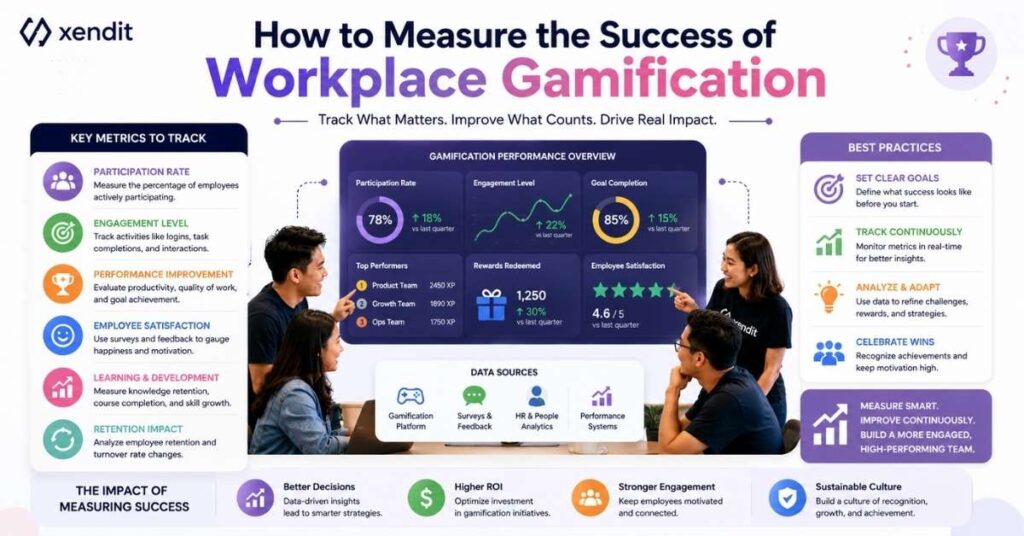
Measuring workplace gamification success requires tracking more than participation numbers. True measurable outcomes show up across engagement, performance, and human experience data simultaneously. Define your success metrics before launch not after.
The strongest measurement frameworks combine quantitative performance metrics with qualitative employee satisfaction data. Numbers tell you what happened. Employee feedback tells you why.
Engagement Metrics
Track participation rate, reward redemption frequency, and activity inside the performance dashboard consistently. Employee Net Promoter Score (eNPS) provides a reliable benchmark for overall workforce engagement health. A rising eNPS alongside growing participation rate signals that your engagement strategy is genuinely working not just generating activity.
Productivity and Performance Indicators
Productivity improvement shows up in task completion rates, project turnaround times, and operational efficiency scores. Compare these numbers before and after implementation carefully. Performance management data should show whether the motivation framework is influencing real work output not just generating enthusiasm inside the gamification platform itself.
Employee Satisfaction and Retention
Employee satisfaction surveys and retention rate data reveal the long-term health of your program. High talent retention combined with strong employee happiness scores indicates that your workplace culture transformation is creating genuine workforce motivation not just temporary excitement. Track these numbers quarterly for the clearest picture of sustainable impact.
Who Can Benefit From the Xendit Gamification Summit?
The Gamification Summit serves a surprisingly broad audience. Whether you lead a human resources team, build products for enterprise clients, or run a startup scaling fast, this event offers directly applicable knowledge and connections.
The content spans strategy and execution equally. You won’t find vague inspiration talks here. Every session connects to real organizational development outcomes that attendees can pursue immediately after returning to their teams.
HR and People Teams
HR leaders gain a complete human resources strategy toolkit for modern workforce experience design. Sessions cover employee development, talent retention, people management, and culture building in distributed organizations. The summit also addresses employee wellbeing specifically an area most engagement initiatives underserve despite its direct connection to retention rate and employee morale.
Startup Founders and Business Leaders
Startup founders and executives discover how to build company culture from scratch using motivational design principles. The summit shows how even small teams with limited budgets can implement effective incentive programs and recognition incentives that drive workforce motivation. Organizational development doesn’t require a massive HR department it requires the right framework applied consistently.
Product, Operations, and Learning Teams
Product managers, operations leads, and learning and development specialists find the technical and strategic sessions most valuable. Developers learn about API integration, cloud technology, and smart automation tools that power effective employee engagement tools. Operations teams explore performance optimization strategies. Learning teams discover how gamified learning and challenge-based learning dramatically improve training outcomes across remote and hybrid workforces.
Read More: URL Encoder Spell Mistake: 44 The Complete Guide to Fixing Encoding Errors
The Future of Workplace Gamification
Workplace gamification is moving toward deeper intelligence and stronger personalization. Predictive analytics will soon identify disengagement patterns days before employees consciously feel them. AI-driven engagement systems will recommend wellness breaks, personalized learning paths, and collaborative quests automatically based on behavioral signals without managers needing to intervene.
Digital transformation across every industry is accelerating this shift. As hybrid work culture becomes permanent for millions of knowledge workers, companies need workplace technology that maintains workplace connection across distributed teams. The organizations investing in employee experience management today will face significantly lower employee burnout and higher talent retention in the years ahead. The tools are ready. The question is whether leadership is willing to use them.
Frequently Asked Questions
What makes Xendit Gamification Summit Work different from traditional rewards programs?
Traditional employee recognition programs offer occasional bonuses and annual reviews. Xendit Gamification Summit Work delivers continuous workforce engagement through real-time dashboard visibility, collaborative quests, AI personalization, and digital rewards that employees can redeem on their own terms. That daily rhythm of recognition creates workplace belonging and employee motivation that one-time rewards simply cannot sustain.
Does workplace gamification actually improve productivity?
Yes when designed correctly. Workplace gamification frameworks that reward meaningful contribution rather than raw activity improve both workplace productivity and employee satisfaction simultaneously. Companies implementing well-designed gamification mechanics report measurable gains in performance metrics, participation rate, and goal tracking consistency within the first few months of launch.
Can small businesses implement a similar strategy?
Absolutely. Startup founders and small business owners can begin with a lightweight points system, simple achievement badges, and a basic recognition system before scaling into more complex engagement strategy tools. The core principles of motivational design and employee involvement work at any company size. Start with one team. Measure results. Expand from there.
How does AI improve employee engagement?
Artificial Intelligence improves employee engagement by making every experience more relevant and personalized. AI-powered recommendations suggest challenges, learning sessions, and collaborative quests based on individual work patterns. Predictive engagement insights help HR leaders identify disengagement risks early. Smart recommendations reduce the generic noise that causes employees to ignore traditional engagement initiatives.
What metrics should companies track to measure success?
Focus on employee Net Promoter Score (eNPS), participation rate, retention rate, reward redemption frequency, and productivity improvement indicators. Combine those with qualitative employee satisfaction surveys for a complete picture. Data analytics tools inside your analytics dashboard should make these performance metrics visible in real time allowing fast adjustments before small problems become expensive ones.
Conclusion
Xendit Gamification Summit Work proves that employee engagement doesn’t require expensive perks or complex systems. It requires consistent recognition, visible progress, and meaningful team collaboration built into the daily flow of work. Xendit demonstrated that a well-designed motivation framework can transform organizational culture without sacrificing authenticity or respect for employees’ time.
The future belongs to organizations that treat workforce engagement as a continuous practice not an annual event. Whether you’re an HR leader, a startup founder, or a product manager building the next generation of workplace technology, the principles behind Xendit Gamification Summit Work offer a proven, human-centered path forward. Start small. Measure everything. Keep improving.